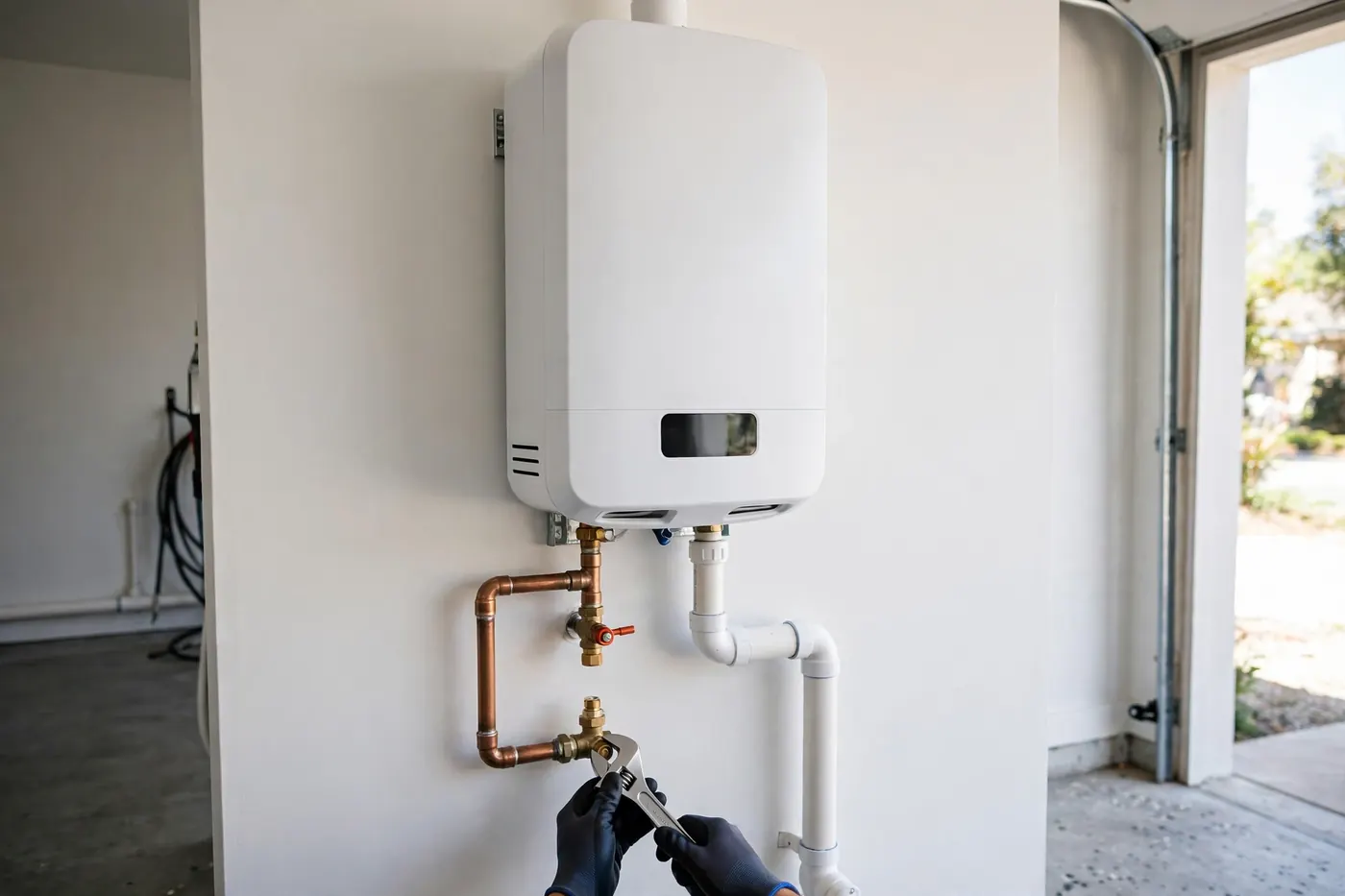
Tankless water heater mounted on a garage wall with copper piping in a Seagoville home
Seagoville, Texas · ZIP 75159

Tankless Water Heater Installation in Seagoville, TX

A tankless water heater heats water as it flows, so the hot water does not run out and there is no tank to leak. For Seagoville's larger households, averaging about 3.3 people, and for homes short on floor space, a wall-mounted tankless unit is often the better install. It does need the right sizing, the right venting and annual descaling in this city's hard water.

Call (833) 382-2711 Two showers at once while the dishwasher runs? That is a sizing question. Call and describe the household.

Open Mon-Fri, 7am-6pm

  • Endless hot water, sized by flow rate for the household
  • Wall mounted: floor space back in the garage or utility room
  • About 20 year expected life, with annual descaling in hard water
  • Seagoville onlyOne city, full focus
  • ZIP 75159Every neighbourhood covered
  • Licensed-plumber workDone to Texas code
  • Permit handledOpenGov filing and inspection arranged

Tankless water heater installation in Seagoville: the quick answer

Call (833) 382-2711 for tankless water heater installation anywhere in Seagoville, TX. A tankless unit is sized by flow rate, not gallons, so the household's simultaneous use decides the size. Gas tankless installs often need a larger gas line and new venting; electric units need enough panel capacity.

In Seagoville hard water, about 9.5 grains per gallon, a tankless unit needs annual descaling or scale blocks the heat exchanger. Service valves fitted at install make that a routine job. See tankless water heater repair and descaling for the maintenance side.

How it works

How a tankless water heater works

A tankless unit has no stored hot water. When a hot tap opens, cold water flows through the unit, a flow sensor fires the burner or the heating elements, and the water is heated as it passes through the heat exchanger. Close the tap and the unit shuts down. Nothing is kept hot between uses, so there is no standby heat loss and no tank of water waiting to leak.

The tradeoff is that the supply is endless but flow-limited. A unit can heat only so many gallons per minute, and if the household asks for more than that, the temperature drops. That is why sizing is the whole job: the unit is matched to the fixtures that run at the same time, not to the size of the house.

Simultaneous useWhat it needs
One shower at a timeA smaller unit covers a single fixture.
Two showers at onceA mid-size unit, the common family choice.
Two showers plus dishwasher or laundryA larger unit, or two units for a big home.
Whole home with a large tubCheck the tub's fill rate; a soaking tub can exceed a single unit.
Sizing is the whole job

Sizing a tankless unit: flow rate, not gallons

Tank sizing is measured in gallons. Tankless sizing is measured in gallons per minute, and it follows the household's worst moment, not its average: the morning when two showers run while the dishwasher is on. Seagoville households average about 3.3 people, so many homes here need a unit sized for simultaneous use, and a household with teenagers on different schedules needs more still.

Incoming water temperature matters too, and it is the part most often missed. Groundwater is colder in winter, so the unit has to lift the temperature further and its effective flow drops. A Seagoville installer sizes for the coldest months, not the yearly average, so the unit keeps up in January as well as in July.

Gas tankless

Gas units give a higher flow rate, which suits a household that runs several fixtures at once. They need a gas line that can feed them, which often means upsizing the line from the tank it replaces, and a venting run: condensing units vent through plastic pipe and need a condensate drain, while non-condensing units need metal venting. Atmos Energy offers rebates on efficient gas tankless units while funds last.

Gas installs in Seagoville

Electric tankless

Electric units need no venting and no gas line, which makes the install simpler, but they need enough panel capacity and dedicated circuits, and the flow they can heat is lower than a gas unit of the same price. They suit smaller households, or a single point of use such as a distant bathroom that waits too long for hot water.

Electric installs in Seagoville
What to expect

What a tankless installation involves

A tankless install takes longer than a like-for-like tank swap, because of the venting and gas or electrical work. Here is the shape of the job.

Sizing and site survey

The household, the fixtures and the simultaneous use decide the size. Then the site is checked: the gas line or the panel, the venting route, the mounting wall, and where the condensate drain runs on a condensing unit.

Gas, venting and water

The gas line is upsized where needed, the venting is run, and the water lines are connected with service valves fitted for descaling. Condensing units get a condensate drain. The old tank, where there is one, is drained and removed.

Mount, connect and test

The unit is mounted, connected, fired and tested at full flow, with the temperature set and the fixtures checked one by one. The permit inspection is arranged, and the descaling schedule is set from the first year.

Cost, honestly

What decides the cost of a tankless installation?

A tankless install costs more than a tank swap, and the reasons are all in the work around the unit rather than the unit itself. These are the factors that move the cost.

  • Unit capacity. A higher flow rate means a larger unit and more work to feed it.
  • Gas line upsizing. A tankless unit usually needs a larger gas line than the tank it replaces.
  • Venting run. The length and route of the venting, and whether it is condensing or non-condensing.
  • Electrical work. Electric units need panel capacity and dedicated circuits.
  • Location. A garage wall is straightforward; a long run to the fixtures adds pipe work.
  • Permit and inspection. Seagoville typically requires a permit and an inspection.

What drives the cost in your home?

Call (833) 382-2711 and describe the current heater and the household. That is usually enough for a straight answer on which factors apply to your install and which do not.

The cost factors summary on the home page lists the same factors in one place.

Call (833) 382-2711
The Seagoville catch

Hard water is the one thing a tankless install must plan for

Seagoville tap water measures about 9.5 grains per gallon, firmly in the hard band, and a tankless heat exchanger is the narrowest passage that hard water flows through. Scale coats it, narrows it and blocks it, and the symptoms follow: fluctuating temperature, error codes, low flow, and in the end a unit that stops heating at all.

The lesson is documented, not guessed. In one study, a tankless unit running on very hard water at 26 grains per gallon failed from scale blockage after the equivalent of about 1.6 years of use. Seagoville water is softer than that, at about 9.5 grains, but the lesson holds: descaling is not optional here. Annual descaling keeps the temperature steady, the flow up and the unit on track for its expected life of about 20 years.

Service valves fitted at install make descaling a routine job. A unit installed without them needs the valves added before it can be descaled properly, which is one more reason the install matters.

Descaling and tankless repair →

Permits for a tankless install

In most cases, a permit and inspection are required. Seagoville has adopted the 2024 International Codes with city amendments and the 2023 National Electrical Code. Contractors must register with the city before applying for a permit, permits are issued through the city's OpenGov portal, and inspections are scheduled on 972-287-6829. Your plumber pulls the permit and arranges the inspection.

Texas law requires plumbing work offered to the public to be performed by or under a licensed plumber, and a Responsible Master Plumber pulls the permit.

The Seagoville permit process
No sales talk

The honest downsides of tankless

Every honest page about tankless should list these. None of them is a reason to avoid tankless. They are reasons to size and install it properly.

Higher install cost

Venting, gas line upsizing and electrical work make a tankless install cost more than a tank swap. The unit lasts longer, but the payback takes years.

Flow limits

Too many fixtures at once and the temperature drops. Sizing for simultaneous use, not average use, is what prevents this.

Cold-water sandwich

A brief slug of cold water can arrive between uses, as the unit fires up again. Most households stop noticing it within a week.

Minimum flow

A trickling tap may not trigger the burner, so a very low flow can run cold. Opening the tap further fixes it.

Annual descaling

In Seagoville hard water, descaling is yearly maintenance, not a one-off. Skipping it is how a 20 year unit fails early.

Freeze exposure

A tankless unit holds little water, but its pipes and heat exchanger can still freeze in an unheated space. Indoor mounting, insulation and a drain-down before a hard freeze are the protection that matters.

In February 2021, Winter Storm Uri held the Dallas-Fort Worth area at or below freezing for 139 consecutive hours, and freezing pipes were the top cause of property damage in the more than 500,000 insurance claims filed statewide. A tankless install in a garage or an exterior wall plans for the next cold snap from day one.

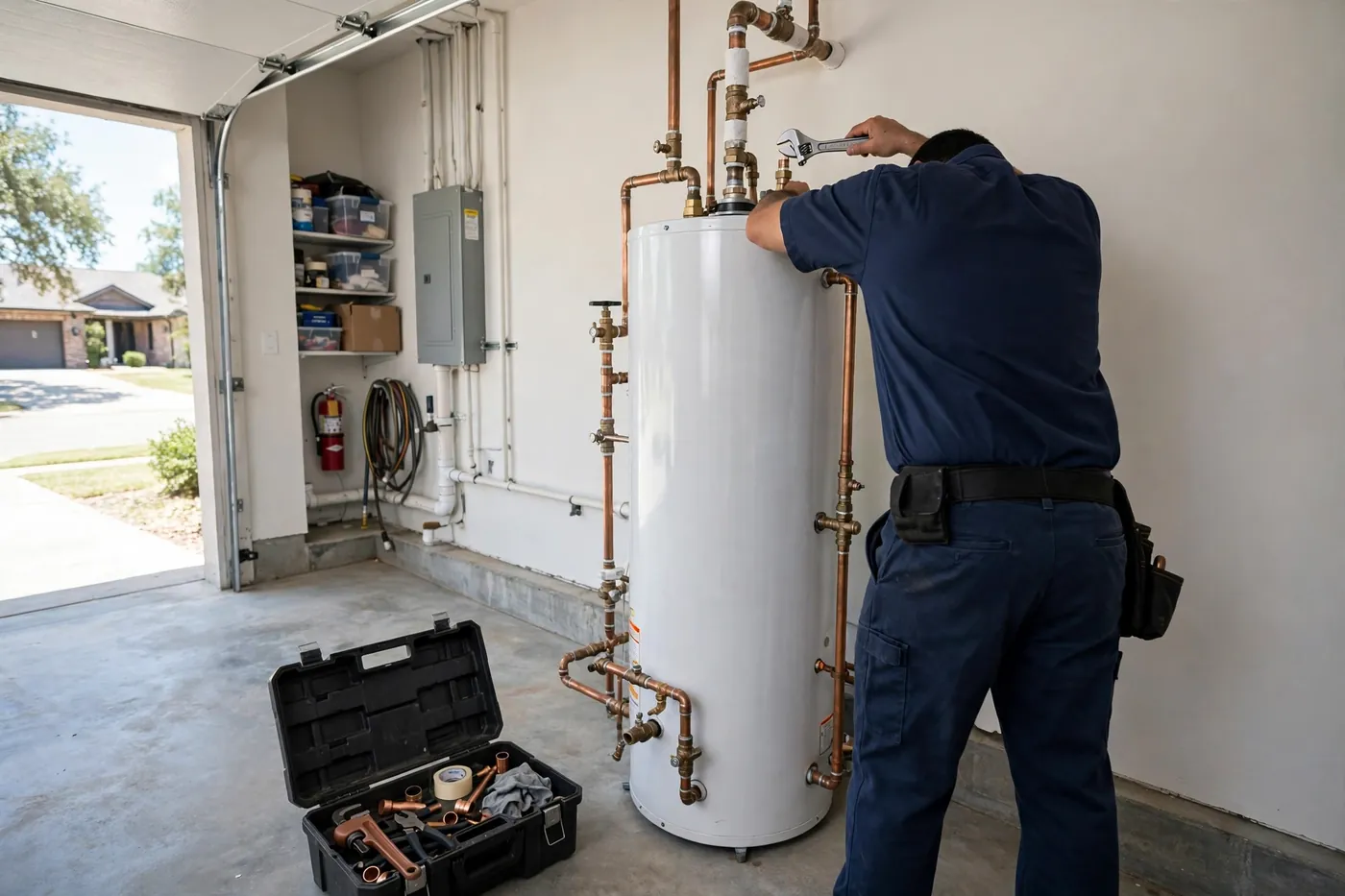
Plumber installing a new tank water heater with copper water lines in a Seagoville home garage

A tank install is the simpler like-for-like swap; tankless suits larger households and tight spaces.

Local, and only local

Tankless installation across Seagoville

Tankless installs cover every part of Seagoville in ZIP code 75159. The newer subdivisions in the north are the natural tankless market, with larger homes and larger households, while the older streets around Malloy Bridge Road, Seagoville Road and Kaufman Street are where tank-to-tankless switches happen at replacement time. Either way, one call covers it.

  • Seagoville Farms
  • Edmonds Ranch
  • Stonehaven
  • Cottonwood Creek
  • Santorini
  • Tredway Estates
  • Malloy Bridge Road area
  • Seagoville Road area
  • Kaufman Street area
  • US-175 frontage

See the full breakdown on the Seagoville service area page.

Keep looking

Related water heater services in Seagoville

Not the page you need? These services sit closest to this one, and the hub lists all ten.

Questions

Tankless water heater installation in Seagoville: frequently asked questions

How much does tankless water heater installation cost in Seagoville?

The cost depends on the unit's flow capacity, whether the gas line needs upsizing, the venting run, any electrical work, where the unit mounts, and the permit and inspection. A tankless install usually involves more venting and gas or electrical work than a like-for-like tank swap, which is why it costs more to install even though the unit itself is smaller. Call (833) 382-2711 and describe your current heater for a straight answer on what drives the cost in your home.

What is the downside of a tankless water heater?

The honest downsides are a higher install cost than a tank swap, a flow limit (too many fixtures at once and the temperature drops), a brief slug of cold water between uses known as a cold-water sandwich, and a minimum flow rate, so a trickling tap may not trigger the burner. In Seagoville hard water there is one more: the unit needs annual descaling or scale blocks the heat exchanger. None of these is a reason to avoid tankless; they are reasons to size and install it properly.

Tankless vs tank water heater in Texas: which is better?

A tank heater costs less to install and is the simpler like-for-like replacement, while a tankless unit gives endless hot water, takes up wall space instead of floor space, and lasts about 20 years against 8 to 12 years for a tank. In Seagoville hard water, a tankless unit needs annual descaling or scale will block the heat exchanger. Atmos Energy offers rebates on efficient gas tank and tankless units while funds last.

What size tankless water heater do I need?

Tankless sizing is measured by flow rate, in gallons per minute, not by gallons stored. The size follows the fixtures that run at the same time: one shower, two showers, or two showers plus the dishwasher or laundry. Seagoville households average about 3.3 people, so many homes need a unit sized for simultaneous use. Incoming water temperature matters too: the unit is sized for the coldest months, when groundwater is coldest and the heater works hardest.

How long does tankless water heater installation take?

Longer than a like-for-like tank swap, because of the venting and gas line or electrical work. A gas tankless install often needs a larger gas line and a new venting run, and an electric unit needs enough panel capacity and dedicated circuits. The timing is confirmed on the call once the current setup is described, and the permit inspection follows the install.

How often should a tankless water heater be descaled in Seagoville?

Once a year. Seagoville tap water is hard, about 9.5 grains per gallon, and scale builds up in the narrow passages of a heat exchanger faster than in a tank. Annual descaling keeps the temperature steady, the flow up and the unit on track for its expected life of about 20 years. Service valves fitted at install make descaling a routine job.

Do I need a permit to install a tankless water heater in Seagoville?

In most cases, yes. Seagoville has adopted the 2024 International Codes with city amendments and the 2023 National Electrical Code, contractors must register with the city before applying, and permits are issued through the city's OpenGov portal with inspections scheduled on 972-287-6829. Your plumber pulls the permit and arranges the inspection.

Gas or electric tankless: which suits a Seagoville home?

Gas tankless units give a higher flow rate, which suits a household that runs several fixtures at once, but they need a gas line that can feed them and a venting run. Electric tankless units need no venting, but they need enough panel capacity and dedicated circuits, and they suit smaller households or a single point of use. Which fits your home depends on the gas line, the panel and the household's simultaneous use.


Hot water that does not run out?

Size the unit for your household, then install it once

Call and describe how your household uses hot water: the showers, the laundry, the dishwasher, all at once.

Call (833) 382-2711
Call (833) 382-2711
Call (833) 382-2711